Ursa Sapiens
  • The Blog
  • Team
  • About Us
  • Categories
  • Blog Archives
    • December 2014
    • November 2014
    • April 2014
    • March 2014
    • February 2014
    • January 2014
    • December 2013
  • Brown TTH

Traumatic Brain Injuries: The Bad and The Ugly

12/29/2018

0 Comments

 
By Mitchell Yeary, '19
Picture
In his book “Scale”, Geoffrey West (a particle physicist by training) talks of how organisms of all sizes are governed by universal laws, and thoroughly explains how those laws can be scaled to explain a wide variety of phenomena about very diverse organisms [1]. Metabolic rate, length of the circulatory system, and lifespan scale according to relatively simple (in the context of particle physics) power laws. He points out, as others have done before him, that all mammals get the same number of heartbeats, about a billion, in their lifetime. Humans, however, became an exception to this trend starting about two hundred years ago, and now get on average two billion heartbeats.
 
Yet West does not suggest that this kind of improvement on human lifespan be continued. On the contrary, he suggests that even the leading causes of death, like heart disease, cancer, strokes, would only allow us to reach the edge of our biological limit. Eventually, West claims, the “wear and tear” from metabolic activity will wear down cells, overtaxing the proliferative capabilities of our cells, and our organs will fail. There is, of course, still great value in curing such pathologies, giving people 40 or 50 years beyond the current life expectancy. It, however, highlights how important it is to focus on pathologies that affect the young, for whom there are many years of quality life left to live.
 
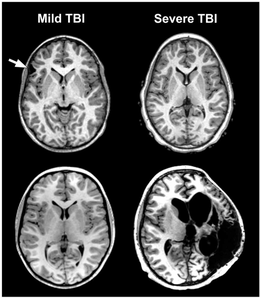
A recent population-based study conducted in Ohio showed that more than 40% of people reported a traumatic brain injury (TBI) at a previous point in their lifetime. Of course, these are not usually due to horrific accidents. The vast majority (80 – 90%) are mild TBIs, what we would call concussions. Mild TBIs are something we hear discussed in our daily lives, often in the context of sports like football and hockey. Most of us have ourselves or know someone who has had at least one concussion. Though they are commonplace, concussions can have long-term effects, and we actually don’t have very effective treatments for TBI’s of any severity. Taking the time to learn a bit more about the consequences of traumatic brain injuries and what we are doing to treat them will be well worth your time.

Traumatic brain injury is the leading cause of death and disability in the US for those under 44 years old [2]. In severe cases, i.e. when a person loses consciousness for more than 30 minutes or has amnesia for more than 24 hours, TBIs can cause catastrophic long-term harm or death. Even, however, with mild TBIs people often have trouble getting back to their previous level of cognitive function, and studies show they are at higher risk for depression or early onset dementia [3] [4].  When symptoms of a mild traumatic brain injury (TBI) persist beyond three months a person is said to have post-concussive syndrome, which can manifest as headache, dizziness, poor concentration, trouble sleeping, or depressed mood [5].
 
Even for those who never experience post-concussive syndrome, and only experience mild TBIs, all of which recover, there are still potential long-term consequences, as chronic traumatic encephalopathy (CTE) is thought to be initiated by repetitive mild TBIs. It is, however, important to note that this condition is relatively rare, not fully understood, and unlikely to occur in someone who suffered a few mild TBIs, for instance, playing club hockey in college. This is a condition that might occur in someone who has spent many years consistently playing a contact sport, especially those who play professionally.
 
Though clinicians and researchers are still researching the pathophysiology behind the disease, it is known to be associated with cognitive impairment, impulsive behavior, memory loss, depression, and substance abuse [6]. It has been clinically well documented, first in retired professional boxers, and then in professional and amateur athletes who played contact sports and veterans. The boxing community was the first to refer to CTE, calling it “punch drunk syndrome” [5].
 
It is safe to conclude we want to avoid traumatic brain injury of any kind, which might seem like an obvious statement, at least until we look at the sports culture promoted for American youth. But some things are always going to be true, accidents happen and Texans love football. Ideally, we would be able to treat TBIs when they did occur. Unfortunately, for mild TBIs the standard of care in most places is just observation and assigning a period of rest. Yet even this neutral approach could be problematic, given that some studies have shown that prolonged rest after mild TBIs can be destructive, while slowly reincorporating exercise could be beneficial for recovery. For more severe cases of TBI, there are treatments aimed at reducing cerebral swelling, such as steroids, diuretics, and surgical procedures. None of these, however, do much more than treat the symptoms of traumatic brain injury and fail to provide many benefits in terms of neurogenesis. 
 
There are some treatments that are currently being developed that more specifically target the underlying mechanism of traumatic brain injuries. Since much of the harm caused by traumatic brain injuries comes from the swelling of the cells after the injury, many treatments try to temporarily reduce the brain's ability to swell. Targets include drugs that target pro-inflammatory signaling molecules, as well as drugs that target water transporters in cells (called aquaporins), hoping to limit the amount of water that enters a cell [5].
Picture
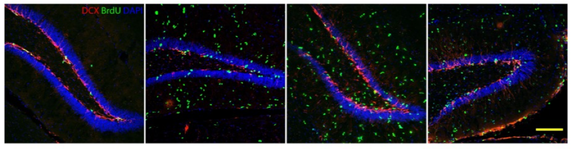
Tissue sample after treated with stem cell factors, showing new growth in regions of the brain [1].
​Another interesting treatment being developed is the use of stem cells from another part of your body to promote healing and regeneration after the traumatic brain injury has occurred. In a number of different studies, researchers have used mouse TBI models to test whether implanting what are called mesenchymal stem cells (usually coming from bone marrow or fat tissue) can help neural recovery. What they have found is that though these stem cells in themselves do not divide and generate more brain tissue, they release molecules that promote other neural cells to do so. They also affect the activity of the immune cells in the brain, making them react in a less damaging manner [8]. This research is ongoing, and in the US is still in animal testing stages (China has a few early human clinical trials using stem cells to treat TBIs). The one caveat to this treatment is that there have been no long-term studies to understand the potential tumorigenic effect of the stem cell treatment. Still, it is another exciting example of the potential future clinical application of stem cells, as the treatment could significantly improve neurological outcomes of people with severe TBIs.
 
It is encouraging that researchers are putting the pieces together, understanding mechanisms, and creating treatments specifically relevant to the cellular and molecular factors involved in TBI. As we move forward, we will hopefully reduce our own exposure to even mild TBIs, and when they cannot be avoided, will have access to effective treatments that allow us to fully recover.
 
Sources:
[1] West, Geoffrey. Scale: the universal laws of growth, innovation, sustainability, and the pace of life in organisms, cities, economies, and companies. Penguin, 2017.
[2] Zhao et al. “Wnt3a, a protein secreted by mesenchymal stem cells is neuroprotective and promotes neurocognitive recovery following traumatic brain injury”, Stem Cells 34, no. 5 (2016).
[3] Holsinger T et al. “Head injury in early adulthood and the lifetime risk of depression”, Arch Gen Psychiatry (2002).
[4] Gardner RC, Yaffe K. “Traumatic brain injury may increase risk of young onset dementia”, Ann Neurol (2014).
[5] Blennow, Kaj, et al. "Traumatic brain injuries", Nature reviews Disease primers 2 (2016).
[6] www.mayoclinic.org/diseases-conditions/chronic-traumatic-encephalopathy/symptoms-causes/syc-20370921
[7] Peng et al. “Systematic review and meta-analysis of efficacy of mesenchymal stem cells on locomotor recovery in animal models of traumatic brain injury”, Stem cell research & therapy 6, no. 1 (2015): 47.
0 Comments


Leave a Reply.

Powered by Create your own unique website with customizable templates.
  • The Blog
  • Team
  • About Us
  • Categories
  • Blog Archives
    • December 2014
    • November 2014
    • April 2014
    • March 2014
    • February 2014
    • January 2014
    • December 2013
  • Brown TTH