Ursa Sapiens
  • The Blog
  • Team
  • About Us
  • Categories
  • Blog Archives
    • December 2014
    • November 2014
    • April 2014
    • March 2014
    • February 2014
    • January 2014
    • December 2013
  • Brown TTH

Technology and Healthcare: What does the future entail?

7/8/2018

0 Comments

 
by Rahul Jayaram, '21
El Amino Hospital in California has experienced tremendous success with its implementation of artificial intelligence technology throughout the clinic floors. The rate at which patients experienced harmful falls dipped 39% below its original value due to the integration of a software that analyzes the patient's behavior along with their health history records to predict the moments in which they may be the most at risk. If at risk for a fall, the patient is moved closer to a nurse station or monitored through video [1]. The use of such a program to assist the El Camino Hospital staff in providing a better quality of life for patients is one of the many positive results of introducing smart technology in the field of healthcare.
Picture
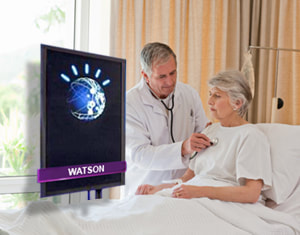
IBM's Watson Learning technology playing a role in medical diagnosis.
Technology is not only used to better the management of patients on the floors but also to improve diagnosis and treatment. For instance, hospitals have recently introduced IBM's reverend Watson question answering computer system, which was able to beat every one of its human competitors in the game “Jeopardy”, into cancer and oncology treatment [1]. No longer will doctors have to continuously scroll through patients records and prescribe subjective treatment, which can be especially challenging in the still elusive field of cancer medicine. Instead, the Watson system can simply analyze all of the patient data and suggest treatments based on the patient health history and the wide realm of medical journals, textbooks, and articles, all in an instant.
It seems that technology is driving the world of healthcare for the better. Hospitals are becoming more efficient and less strain in placed on physicians in their treatment of patients. While such advancement is marvelous, it also brings up the question “Are the roles of physicians and healthcare staff becoming obsolete?” Why depend on the diagnosis of one’s limited memory and skills that is more prone to error than one made by a sophisticated algorithm? Why rely on operations done by hand when machines can perform the same operation much more accurately? Even though it may seem that robots will take over healthcare in the near future, human doctors will continue to remain critical when it comes to patient treatment.
While medical technology has the ability to collect infinite data and use a program to prescribe the best treatment, as one widens the range of possible treatment, the ability to choose the best next step deteriorates. We have all relied on Dr. WebMD at some point to understand why our head hurts after a long day or find out that we are at risk for hypertension, when in reality it was just a headache that could be cured with a nap. Another key drawback is that the neural networks implemented in diagnosis technology is designed to always spit out a correct answer, even if the input information is not clear [3]. This can create major problems if a patient exhibits a series of symptoms that can make diagnosis confusing, since the technology lacks the ability  to use the intuition and reasoning humans possess to provide a general diagnosis. In other words, such machines lack the “gut feeling” to make the right call.
Also, one of their major roles healthcare staff have is to provide empathy and comfort to patients at a time where they are most vulnerable. The ability to form and connection of trust between patient and provider is something technology simply will never be able to do. This is especially important when dealing with life changing information. Would you rather be told that you have Alzheimer's disease from an application or a human being that you trust in?
There are many bright aspects to look forward to with the integration of revolutionary technology into the medical field. We are raising the global standard for health everyday throughout these innovations, and this advancement is definitely a feat to be praised. However, we should understand that humans will always play a critical role in managing this technology, and that our roles are are not becoming any smaller. In fact, since most of the mundane tasks in medicine are becoming mastered by robots, it is critical that medicine's humanistic aspect is perfected beyond its current state.
References:

[1] Transforming Traditional Models of Fall Prevention Through The Power of Prescriptive Analytics [Internet]. El Camino Hospital. 2017 [cited 2018May4]. Available from: https://www.elcaminohospital.org/newsroom/transforming-traditional-models-fall-prevention-through-power-prescriptive-analytics

[2] Transforming Traditional Models of Fall Prevention Through The Power of Prescriptive Analytics [Internet]. El Camino Hospital. 2017 [cited 2018May4]. Available from: https://www.elcaminohospital.org/newsroom/transforming-traditional-models-fall-prevention-through-power-prescriptive-analytics

​[3] Nielsen MA. Neural Networks and Deep Learning. Determination Press; 2015.

0 Comments


Leave a Reply.

Powered by Create your own unique website with customizable templates.
  • The Blog
  • Team
  • About Us
  • Categories
  • Blog Archives
    • December 2014
    • November 2014
    • April 2014
    • March 2014
    • February 2014
    • January 2014
    • December 2013
  • Brown TTH