Ursa Sapiens
  • The Blog
  • Team
  • About Us
  • Categories
  • Blog Archives
    • December 2014
    • November 2014
    • April 2014
    • March 2014
    • February 2014
    • January 2014
    • December 2013
  • Brown TTH

Cracking the Nutshell of Dangers

4/18/2019

0 Comments

 
​By Kaitlyn Lew '20
Picture
Credit: Roy Scott/Getty Images
“WARNING: May contain peanuts,” reads the label. Every person with a food allergy is familiar with the sinking feeling of reading the allergen-containing food label, including me. Although it is important to scrutinize the ingredients of all foods for certain allergens to avoid adverse, life-threatening reactions, there are also strict restrictions on an individual's food options and behaviors that may divide social circles. People with severe food allergies often have limited food choices. Moreover, children and young adults while growing up may also be prohibited from sitting with friends at other tables for fear of inadvertent allergen exposure and are thus prevented from entering such foodie social circles.
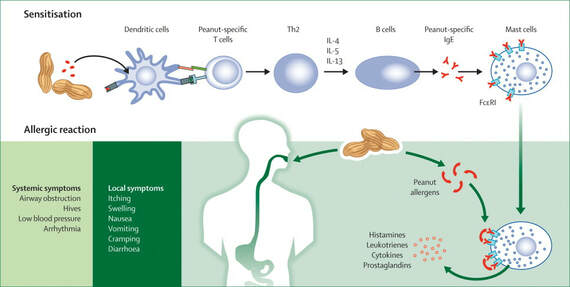
PictureCellular mechanism of an allergic reaction to peanuts Credit: A Wesley Burks, MD
Today, four million children have food allergies in the United States alone, and the severity of reactions to food allergens is no joke, as the consequences can be deadly. If one consumes the allergen, the body’s immune system mistakes an innocuous food molecule for an invasive species and unnecessarily switches to hyperdrive. The body and its complex immune system are analogous to a bank that is protected by a metal detector and comprehensive security system. When an unknown visitor enters the doors, the detector may either remain silent or sound the alarm. However, when an armed robber enters the bank, the metal detector sounds the alarm and police guards swarm the area to confront the intruder. The response is rapid and extensive, so the guards radio in other police members until the whole police network is alerted of the intrusion. Significant efforts are taken to prevent the robber from breaking into the bank vaults. In this scenario, the bank represents the body whereas the potential robbers are viruses, bacterial cells, and other harmful foreign bodies. However, there’s a twist: the normal client entering the bank is mistaken as a robber. This parallels a harmless ingested food molecule being mistaken for a pathogen.

Initially, the skin, including the lining of the digestive tract, is the first line of defense like a metal detector. However, when the food particle enters the body, mast cells sound the immune system’s alarm and histamine is released to inflame the skin and produce a rash. Then the “guards”, or immunoglobulin E, are signaled. There are two types of responses: IgE-mediated and non-IgE mediated. Immunoglobulin E (IgE) is an antibody from the body’s immune system designed to attack a perceived threat.  Normally, IgE is a glycoprotein produced by white blood cells to identify and destroy viruses or bacterial cells that pose a threat to the body. Increasing amounts of IgE are produced in the presence of an allergen and may lead to anaphylaxis, or swelling and hives that may escalate to a deadly anaphylaxis shock. IgE-mediated reactions are faster with symptoms showing 1-2 hours after ingestion of the allergen, whereas non-IgE-mediated responses occur several hours after ingestion [1].

Many people are at risk of such a vigorous response from their immune system. In the United States, approximately 6% of children and 3.7% of adults have food allergies [2]. In total, about 4 million children are affected by food allergies. According to the 1997-2011 National Health Interview Survey, there is a trend that the number of children with food allergies is directly proportional to income. Among children in families whose incomes are “less than 100% of the poverty level, 4.4% had a food allergy” whereas “[a]mong children with family income above 200% of the poverty level, food allergy prevalence was 5.4%” [3]. The reported number of children with food allergies has steadily increased over the past decade. This growing trend may be paradoxically caused by improved hygiene and the avoidance of introducing young children to various foods and microbes for fear of developing sensitivity and a reaction.

With increasing numbers of individuals having allergies, how should  those recently diagnosed with allergies manage them? The straightforward and common approach is to completely eliminate the allergen from one’s diet. For consumers with allergies, it is vital to read the food labels. In 2004, the FDA passed the Food Allergen Labeling And Consumer Protection Act (FALCPA) to improve food labeling [4]. Companies are now required to declare the presence or contamination of a food or protein in one of the eight major food allergy groups (milk, eggs, fish, Crustacean shellfish, tree nuts, peanuts, wheat, and soybeans). Oftentimes, food labels explicitly state the presence of such allergy groups in a bolded subsection beneath the ingredients list. Such precautions clearly and conspicuously alert consumers of known life-threatening allergens. Nevertheless, there remains the risk of accidentally ingesting the allergen as a contaminant in food and initiating a life-threatening reaction. To avert this potential danger, some patients resort to immunotherapy in which patients systematically consume trace amounts of the food allergen under a physician’s supervision for a few months. By consistently consuming the allergen in small portions, the immune system may be able to build a tolerance to minimize the allergen effects. However, there still remains a small potential risk for a serious reaction. With age, the immune system is less susceptible to change and cannot build enough tolerance to overcome the risk of an allergic response.

PictureOral challenge administered to a child. Credit: Dave Bloom
Recently, the American Academy of Asthma, Allergy, and Immunology (AAAI) has released new guidelines to prevent developing allergies through earlier exposure. According to recent research, feeding infants between four to six months-old a potential allergen in a controlled and physician-monitored amount may prevent such severe allergies from developing later in life. However, a new food should only be introduced once every three to five days [5]. These are known as “oral food challenges.” Early exposure may build the immune system’s allergen tolerance within the first few months of birth, which is the critical period when the immune system is most susceptible to change. This research has sparked hope for reversing the rising prevalence of food allergies in the population. Unfortunately, this clinical exposure to the allergen at a young age only applies to children with family histories of allergies.

Food allergies affect not only families but also the national government. While individuals and families face insurmountable health care costs, each individual’s food allergy also creates a ripple effect on a national level. In 2013, food allergies costed the U.S. healthcare system $24.8 billion nationally, with about $4,184 spent per child. Direct medical costs are about $4.3 billion annually, which includes medical visits to allergists and emergency room visits. Recently, the cost for one Epi-Pen has also risen from an estimated $100 in 2008 to an astronomical $600 today [6]. Even insurance companies can only cover about $500 of the cost with a copay of $100 on the family. As insurance bills and medical costs escalate, food allergies are becoming increasingly problematic.

Since  food allergies have been so prevalent and disruptive in society social media has been focusing on the severity and consequences of some allergies. In 2016, Face Your Risk released a commercial demonstrating the first-hand experience of a person at a party having anaphylaxis, with the audience viewing the scene as the narrator. It attracted public attention and stimulated a media storm on Twitter called #FaceYourRisk to raise awareness for the deadly consequences of allergies. However, given the widespread problems of food allergies in the nation, it is imperative that the public becomes more aware of the implications of food allergies and how to handle emergency situations that could save lives. As research progresses towards eliminating food allergies, perhaps we will completely lift the barricades surrounding food allergy groups and enable those with allergies to enjoy eating all foods and new dishes without anxieties or worries.
Picture
Credit: Michelle Kondrich for NPR
Citations
[1] Fiocchi, Alessandro, MD, and Vincenzo Fierro, MD. "Food Allergy." World Allergy Organization. World Allergy Organization, Mar. 2017. Web. 18 Mar. 2017.
[2] Sicherer, S.H., Sampson, H.A. “Continuing Medical Education examination: Food allergy.” Journal of Allergy and Clinical Immunology, Vol. 117, Issue 2, Supplement 2, S470-S475. February 2006. Web. 18 Mar. 2017.
[3] Jackson, Kristen D., MPH, LaJeana D. Howie, MD, and Lara J. Akinbami, MD. "Trends in Allergic Conditions Among Children: United States, 1997–2011." Centers for Disease Control and Prevention. Centers for Disease Control and Prevention, 02 May 2013. Web. 18 Mar. 2017.
[4] 150 U.S. Food and Drug Administration, Center for Food Safety and Applied Nutrition 905-911 (2006) (enacted). Print.
[5] Fleischer, David M., MD, Jonathan M. Spergel, MD, PhD, Amal H. Assa'ad, MD, and Jacqueline A. Pongracic, MD. "Primary Prevention of Allergic Disease Through Nutritional Interventions." American Academy of Allergy, Asthma & Immunology. Elsevier Inc., 2012. Web. 18 Mar. 2017.
[6] Gupta, R., D. Holdford, L. Bilaver, A. Dyer, JL Holl, and D. Meltzer. "The Economic Impact of Childhood Food Allergy in the United States." JAMA Pediatrics. U.S. National Library of Medicine, Nov. 2013. Web. 18 Mar. 2017.
[7] "Every 6 Minutes, Life-threatening Food Allergies Send Someone to the Hospital." Face Your Risk | What Is Anaphylaxis? Face Your Risk, 2017. Web. 18 Mar. 2017.
0 Comments


Leave a Reply.

Powered by Create your own unique website with customizable templates.
  • The Blog
  • Team
  • About Us
  • Categories
  • Blog Archives
    • December 2014
    • November 2014
    • April 2014
    • March 2014
    • February 2014
    • January 2014
    • December 2013
  • Brown TTH